
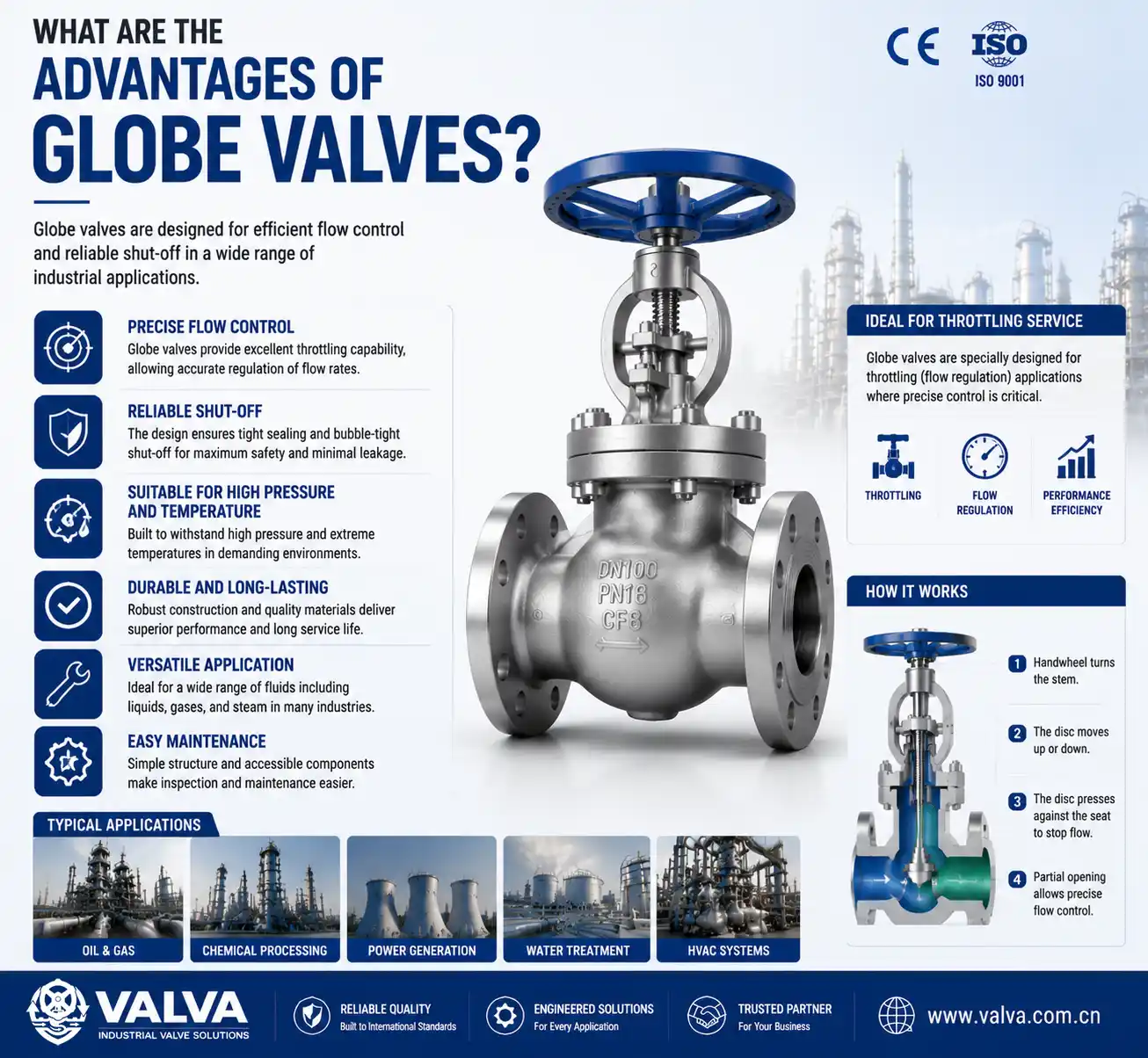
Direct Answer
The main advantages of globe valves are precise flow control, reliable shut-off, excellent throttling performance, and easy maintenance. These features make globe valves one of the best choices for applications that require accurate regulation of fluid flow rather than simple on-off operation.
Excellent Flow Control
One of the biggest advantages of a globe valve is its ability to regulate flow accurately.
Its linear-moving disc allows operators to:
- Adjust flow gradually
- Maintain stable flow rates
- Prevent sudden pressure changes
- Achieve precise process control
As a result, globe valves are widely used in systems where flow must be continuously adjusted.
Superior Throttling Performance
Unlike many other valve types, globe valves are specifically designed for throttling.
Their internal design allows:
- Smooth flow regulation
- Stable pressure control
- Reduced flow fluctuations
- Consistent operating performance
Because of this, globe valves are preferred for steam, cooling water, and chemical process systems.
Reliable Shut-Off
When fully closed, the disc presses tightly against the seat to create a dependable seal.
This provides:
- Low leakage rates
- Improved system safety
- Reliable isolation during maintenance
- Better control of high-pressure fluids
Properly maintained globe valves can deliver long-lasting sealing performance.
Easy Maintenance
Most globe valves have a bonnet design that allows internal components to be serviced without replacing the entire valve.
Maintenance tasks often include:
- Replacing the disc
- Repairing or changing the seat
- Repacking the stem seal
- Inspecting internal parts
This reduces downtime and lowers maintenance costs.
Suitable for High-Pressure and High-Temperature Service
Globe valves perform well in demanding operating conditions.
They are commonly used in systems handling:
- High-pressure steam
- Hot water
- Thermal oil
- Industrial gases
- Process chemicals
Their robust construction helps ensure reliable operation under severe conditions.
Long Service Life
When selected correctly and maintained regularly, globe valves offer a long operating life.
Key factors include:
- Durable metal components
- Wear-resistant seating surfaces
- Replaceable internal parts
- Proven industrial design
Routine maintenance further extends valve lifespan.
Versatile Applications
Because of their precise control capabilities, globe valves are widely used in:
- Oil and gas facilities
- Power plants
- Chemical processing
- Water treatment systems
- Marine engineering
- HVAC systems
- Industrial manufacturing
Their versatility makes them suitable for a broad range of process industries.
Are There Any Disadvantages?
Although globe valves offer many benefits, they also have some limitations.
These include:
- Higher pressure drop than gate or ball valves
- More operating force required for larger sizes
- Less suitable for full-flow applications
- Generally higher cost than simple isolation valves
However, when accurate flow regulation is the priority, these trade-offs are often acceptable.
Conclusion
The advantages of globe valves include excellent flow regulation, reliable shut-off, easy maintenance, and dependable performance under high pressure and high temperature. These strengths make them one of the most widely used control valves in industrial piping systems.
Frequently Asked Questions
What is the biggest advantage of a globe valve?
The biggest advantage is its precise throttling capability, allowing accurate control of fluid flow.
Why are globe valves preferred over gate valves for flow control?
Globe valves regulate flow smoothly, while gate valves are primarily designed for full open or full closed service.
Are globe valves suitable for high-pressure applications?
Yes. Globe valves are commonly used in high-pressure and high-temperature systems such as steam, power generation, and chemical processing.
Related Articles
Technical & Design Insights
Materials & Standards
Maintenance & Operation
Commercial & Purchasing Topics
- Globe Valve Manufacturer China
- Industrial Globe Valve Supplier Oil & Gas
- Stainless Steel Globe Valve Factory Direct Supplier
- Globe Valve Price List DN15 to DN200
- High Pressure Globe Valve Supplier
- Globe Valve Quotation Request Fast Delivery
- Cast Steel Globe Valve Supplier Power Plant
- Globe Valve Bulk Order OEM Manufacturer
- Globe Valve Wholesale Price Industrial Use