
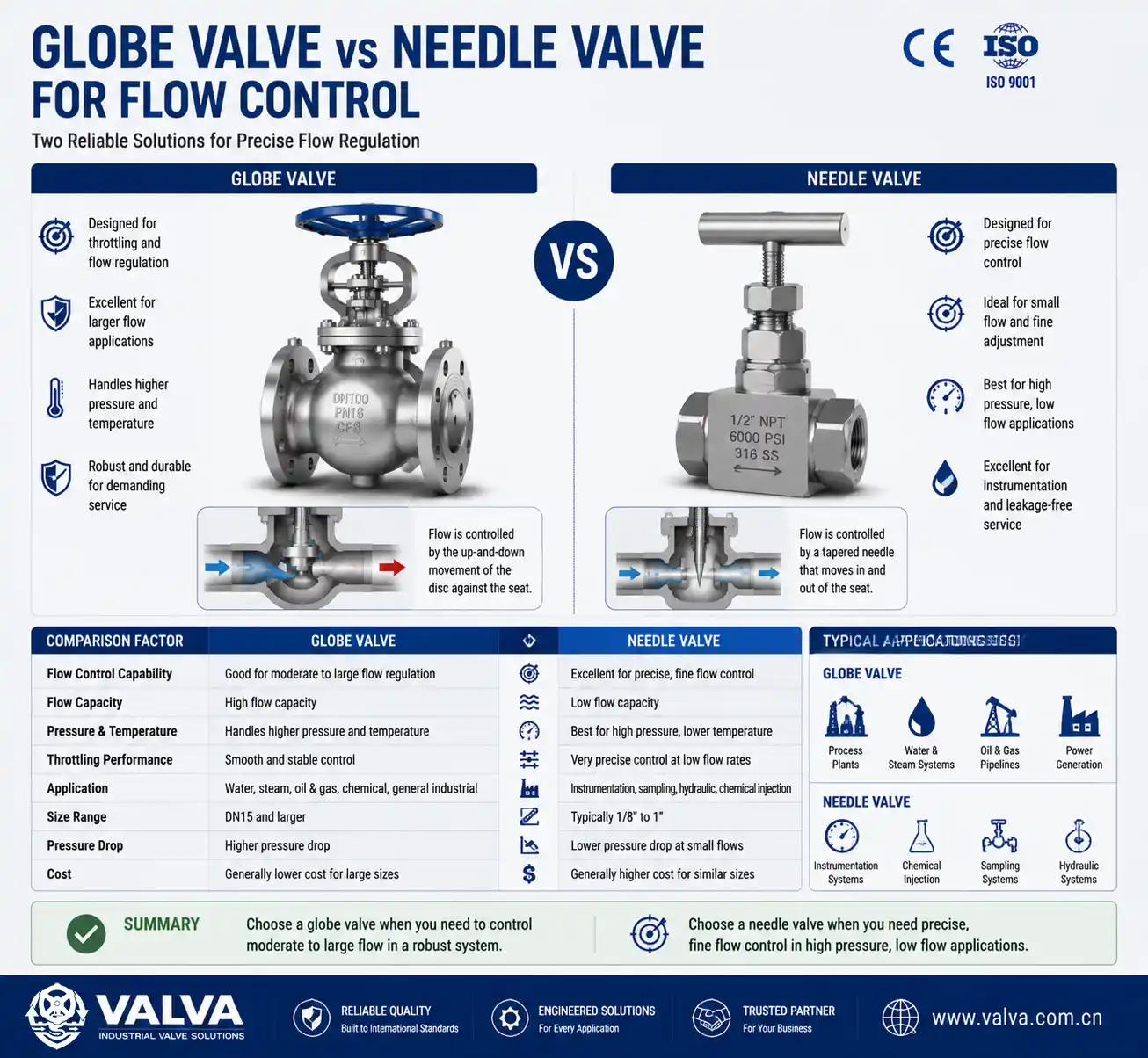
Direct Answer
Globe valves and needle valves are both excellent for flow control, but they serve different purposes. Globe valves are best for regulating medium to high flow rates in industrial piping systems, while needle valves provide extremely precise control of low flow rates in instrumentation and laboratory applications.
What Is the Difference Between a Globe Valve and a Needle Valve?
Both valves use a linear-motion stem that moves a sealing element toward or away from a seat. However, their internal designs are optimized for different levels of flow control.
| Feature | Globe Valve | Needle Valve |
|---|---|---|
| Flow control | Excellent | Extremely precise |
| Flow capacity | Medium to high | Very low |
| Pressure drop | Moderate to high | High |
| Best application | Process control | Fine flow adjustment |
| Typical pipe size | ½–24 in. or larger | ⅛–1 in. |
| Operating speed | Moderate | Slow |
| Cost | Moderate | Lower for small sizes |
If your application involves controlling the flow of large volumes of fluid, a globe valve is usually the better option. If you need to make very small flow adjustments, a needle valve offers greater precision.
Globe Valve for Flow Control
Globe valves are designed specifically for throttling and regulating flow in industrial systems.
Their disc moves perpendicular to the seat, allowing gradual changes in the flow area. This design provides stable and repeatable flow regulation across a wide operating range.
Advantages
- Excellent throttling performance
- Suitable for large pipe sizes
- Reliable shut-off capability
- Handles high temperatures and pressures
- Available in many body styles and materials
Common Applications
- Steam systems
- Water treatment plants
- Chemical processing
- Oil and gas pipelines
- Power generation
- HVAC systems
Needle Valve for Flow Control
A needle valve uses a long, tapered needle-shaped stem that fits into a small seat opening.
Because the flow passage changes very gradually, operators can make extremely fine adjustments to the flow rate.
Advantages
- Exceptional flow control accuracy
- Ideal for low-flow applications
- Smooth adjustment
- Compact design
- Excellent for instrumentation systems
Common Applications
- Pressure gauges
- Hydraulic systems
- Pneumatic controls
- Laboratory equipment
- Gas sampling systems
- Instrument air lines
Which Valve Offers Better Flow Control?
The answer depends on the required flow rate and control accuracy.
Choose a Globe Valve if You Need:
- Medium or high flow rates
- Continuous process control
- Industrial piping systems
- Steam or hot water regulation
- Frequent throttling
Choose a Needle Valve if You Need:
- Extremely low flow rates
- Precise metering
- Instrument calibration
- Pressure measurement systems
- Laboratory or analytical equipment
In general, globe valves provide excellent control over a broad operating range, while needle valves deliver superior precision for small flows.
Advantages and Disadvantages
Globe Valve
Pros
- Excellent throttling capability
- Suitable for larger systems
- Durable under demanding conditions
- Good shut-off performance
Cons
- Higher pressure drop
- Larger and heavier
- Requires more operating torque
Needle Valve
Pros
- Extremely accurate flow adjustment
- Compact and lightweight
- Ideal for low-flow service
- Simple operation
Cons
- Limited flow capacity
- Not suitable for large pipelines
- Slower to open and close
- Can clog when handling dirty fluids
How to Choose the Right Valve
Consider these factors before selecting a valve for flow control:
| Consideration | Globe Valve | Needle Valve |
|---|---|---|
| High flow rates | ✓ Best choice | ✗ Not suitable |
| Fine flow adjustment | Good | ✓ Best choice |
| Large pipelines | ✓ Yes | ✗ No |
| Instrumentation | Limited | ✓ Excellent |
| Dirty fluids | ✓ Better | ✗ May clog |
| Steam service | ✓ Excellent | Limited |
Selecting the correct valve improves control accuracy, system efficiency, and equipment reliability.
Conclusion
When comparing a globe valve vs. needle valve for flow control, neither valve is universally better. Globe valves are the preferred choice for industrial process control and larger flow rates, while needle valves excel in low-flow applications that require exceptional precision. Understanding your system’s flow requirements, pressure conditions, and control accuracy will help you select the most suitable valve.
Frequently Asked Questions
Is a needle valve more accurate than a globe valve?
Yes. A needle valve provides finer flow adjustment because its tapered stem allows very small changes in the flow opening.
Can a globe valve replace a needle valve?
Only in some applications. A globe valve can regulate flow effectively, but it cannot match the precision of a needle valve for very low flow rates.
Which valve is better for industrial process control?
A globe valve is generally the better choice for industrial process control because it handles higher flow rates, larger pipe sizes, and demanding operating conditions.
Related Articles
Technical & Design Insights
Materials & Standards
Maintenance & Operation
Commercial & Purchasing Topics
- Globe Valve Manufacturer China
- Industrial Globe Valve Supplier Oil & Gas
- Stainless Steel Globe Valve Factory Direct Supplier
- Globe Valve Price List DN15 to DN200
- High Pressure Globe Valve Supplier
- Globe Valve Quotation Request Fast Delivery
- Cast Steel Globe Valve Supplier Power Plant
- Globe Valve Bulk Order OEM Manufacturer
- Globe Valve Wholesale Price Industrial Use