
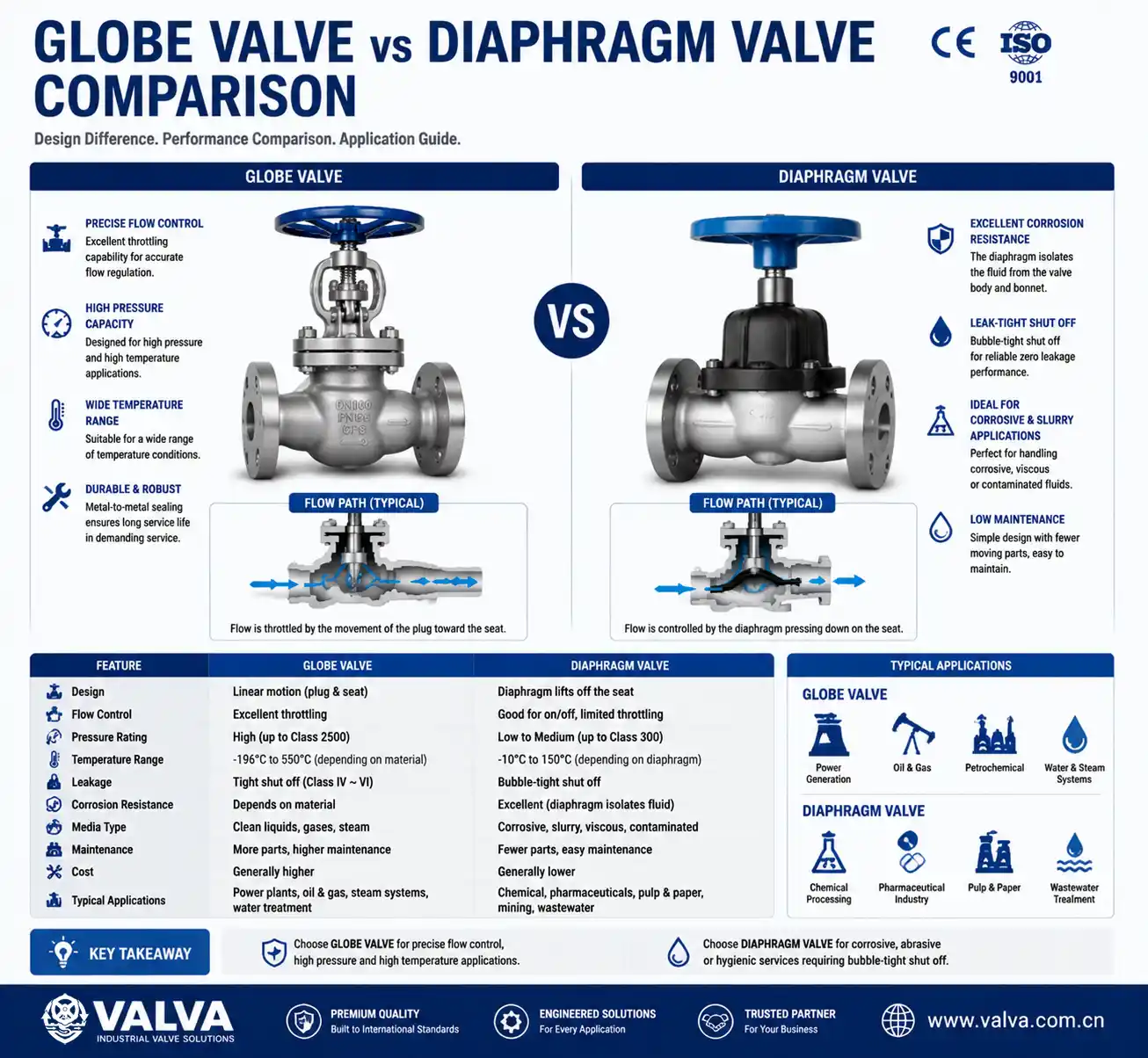
Direct Answer
Globe valves control flow using a moving disc and seat inside a metal body, while diaphragm valves control flow using a flexible diaphragm that presses against a weir or seat. Globe valves are better for high-pressure industrial flow control, while diaphragm valves are better for corrosive, sanitary, or slurry applications.
What Is a Globe Valve?
A globe valve regulates flow using a linear-moving disc and seat mechanism inside a metal valve body.
Key features:
- Excellent throttling performance
- Suitable for high pressure and temperature
- Strong shut-off capability
- Metal-to-metal or soft sealing
Common uses:
- Steam systems
- Oil and gas pipelines
- Power plants
- Chemical processing
- Water treatment systems
What Is a Diaphragm Valve?
A diaphragm valve uses a flexible elastomer or PTFE diaphragm that moves up and down to control flow.
Key features:
- No direct contact between fluid and moving parts
- Excellent corrosion resistance
- Suitable for hygienic applications
- Good for slurries and dirty fluids
Common uses:
- Pharmaceutical industry
- Food and beverage systems
- Water treatment (chemical dosing)
- Slurry and wastewater systems
- Corrosive chemical handling
Globe Valve vs Diaphragm Valve Comparison
| Feature | Globe Valve | Diaphragm Valve |
|---|---|---|
| Flow control | Excellent | Good |
| Throttling ability | Very precise | Moderate |
| Pressure rating | High | Low to medium |
| Corrosion resistance | Depends on material | Excellent |
| Leakage risk | Low | Very low |
| Maintenance | Moderate | Easy |
| Slurry handling | Poor | Excellent |
| Sanitary use | Not ideal | Ideal |
Working Principle Difference
Globe Valve
- Uses a disc + seat system
- Linear motion controls opening size
- Suitable for precise industrial regulation
Diaphragm Valve
- Uses a flexible diaphragm
- Presses against weir or seat
- Isolates fluid from moving parts
Pressure and Temperature Performance
Globe Valve
- Handles high pressure and temperature
- Ideal for steam and industrial pipelines
- Strong metal construction
Diaphragm Valve
- Limited pressure and temperature range
- Depends on diaphragm material (rubber/PTFE)
- Not suitable for high-pressure steam
Advantages Comparison
Globe Valve Advantages
- Precise flow control
- High-pressure capability
- Durable in harsh industrial systems
- Wide application range
Diaphragm Valve Advantages
- Excellent corrosion resistance
- No leakage through stem packing
- Ideal for dirty or corrosive fluids
- Easy maintenance
Disadvantages Comparison
Globe Valve Limitations
- Higher pressure drop
- More wear in throttling service
- Not ideal for slurries
Diaphragm Valve Limitations
- Limited pressure capacity
- Diaphragm wear over time
- Not suitable for high-temperature systems
When to Use Globe Valve
Choose globe valves when you need:
- High-pressure flow control
- Steam or thermal systems
- Precise throttling
- Industrial process regulation
When to Use Diaphragm Valve
Choose diaphragm valves when you need:
- Corrosive fluid handling
- Slurry or wastewater systems
- Hygienic / sanitary applications
- Zero leakage isolation
Conclusion
Globe valves are best for high-pressure industrial flow control, while diaphragm valves are best for corrosive, sanitary, or slurry applications. The correct choice depends on pressure level, fluid type, and system requirements.
Frequently Asked Questions
Which valve is better for high pressure, globe or diaphragm?
Globe valves are better for high-pressure applications because diaphragm valves are limited by membrane strength.
Can diaphragm valves replace globe valves?
Only in low-pressure, corrosive, or sanitary systems. They are not suitable for heavy industrial throttling.
Which valve is more durable?
Globe valves are generally more durable in high-pressure service, while diaphragm valves last longer in corrosive environments.
Related Articles
Technical & Design Insights
Materials & Standards
Maintenance & Operation
Commercial & Purchasing Topics
- Globe Valve Manufacturer China
- Industrial Globe Valve Supplier Oil & Gas
- Stainless Steel Globe Valve Factory Direct Supplier
- Globe Valve Price List DN15 to DN200
- High Pressure Globe Valve Supplier
- Globe Valve Quotation Request Fast Delivery
- Cast Steel Globe Valve Supplier Power Plant
- Globe Valve Bulk Order OEM Manufacturer
- Globe Valve Wholesale Price Industrial Use